
Overview of the Advantages and Applications of Pneumatic Winches
Release time:
2021-11-29
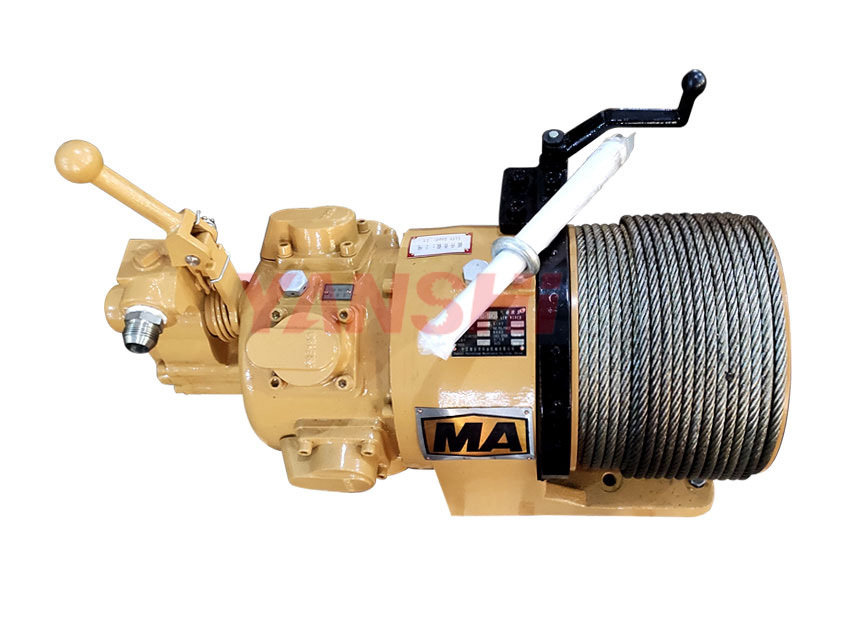
The pneumatic winch is a lightweight and compact lifting device that uses a drum to wind steel wire rope or chains to lift or pull heavy objects. The crane can lift vertically, pull horizontally, or incline to move heavy objects. Winches are divided into manual winches, electric winches, pneumatic winches, and hydraulic winches. Compared to traditional electric hoists, existing pneumatic winches use compressed gas provided by air compressors as a power source.
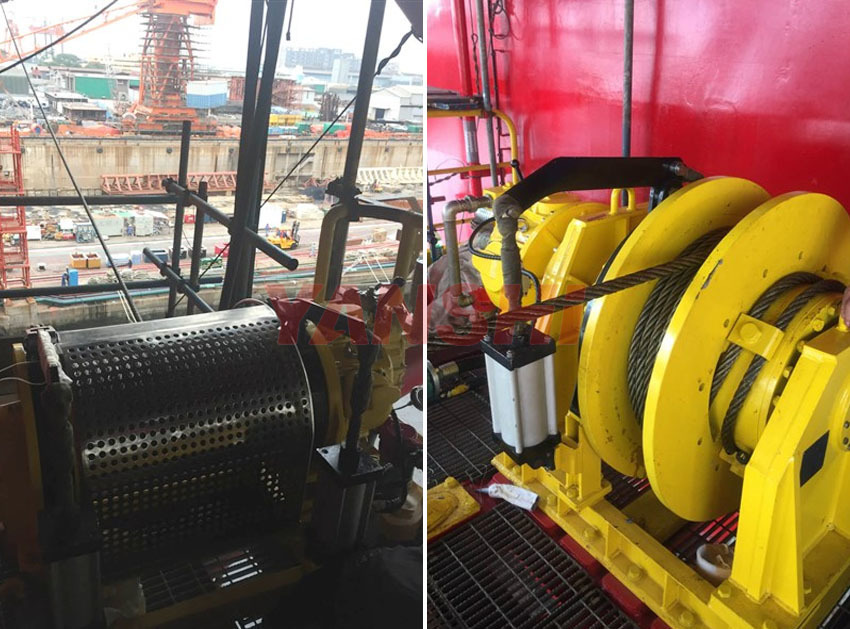
The pneumatic winch is a lightweight and compact lifting device that uses a drum to wind steel wire rope or chain to lift or pull heavy objects. The crane can lift vertically, pull horizontally, or incline to pull heavy objects. Winches are divided into manual winches, electric winches, pneumatic winches, and hydraulic winches. Compared to traditional electric hoists, existing pneumatic winches use compressed gas provided by air compressors as a power source. Compared to traditional pneumatic winches, pneumatic winches have the characteristics of explosion-proof, dust-proof, and liquid splash-proof, making them more suitable for working in harsh environments. Therefore, pneumatic winchesBroadare widely used in shipping, oil extraction, mining, and power industries.
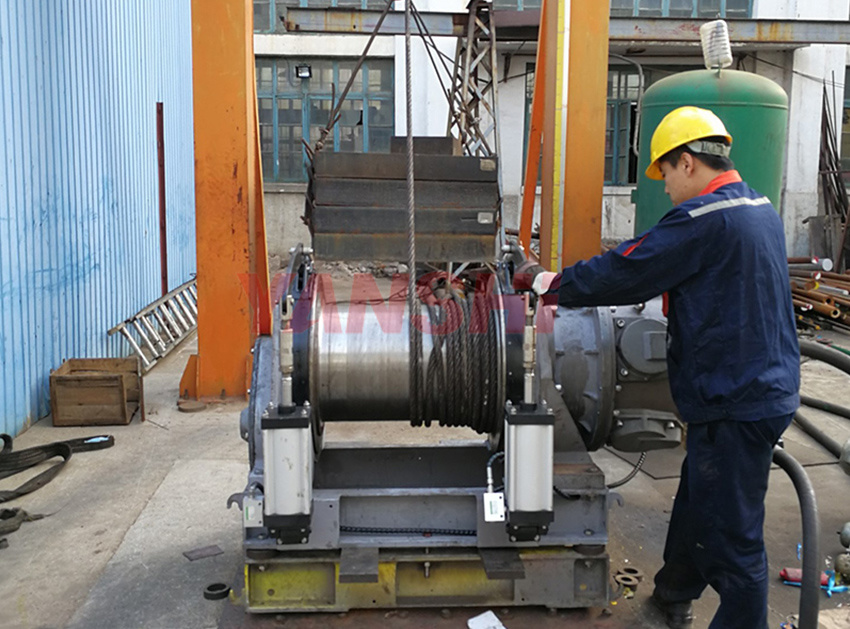
In response to the existing technology'ssome shortcomings,techniciansprovide a pneumatic winch. The pneumatic drive device can fully eliminate the above adverse factors in practical applications, ensuring theeffectiveapplication, and can be freely combined according to the needs of construction operations to meet different operational requirements. At the same time, with the help of pneumatic winches, it can not onlybe wellapplied in oil and gas exploration sites but also in construction sites that require similar operations.
Technical solution: A pneumatic winch, including an outer cylinder, a rotating rod, a rotor, a turntable, an air compressor, and a control valve, where the rotating rod and the rotor fixed on the rotating rod are axially arranged inside the outer cylinder, in which the outer cylinder is a cylindrical tube, and the cylindrical wall of the outer cylinder is symmetrically provided with air inlets and outlets with positive and negative45°cutting angles; the turntable is arranged at the bottom of the outer cylinder, and the turntable includes a chassis that is sealed and fixedly connected to the bottom of the outer cylinder, a through shaft fixed on the chassis along the axis of the rotating rod, an intermediate plate sleeved outside the through shaft and rotatingly matched with the through shaft, and a top plate fixed on the top of the through shaft, where the upper and lower surfaces of the intermediate plate are respectively rotatably matched with the top plate and the chassis; the bottom end of the rotating rod spans the top plate and is fixedly connected to the intermediate plate, the upper part of the rotating rod passes through the top of the outer cylinder, and the extending end is provided with an adapter, forming a rotating dynamic sealing fit at the junction of the rotating rod and the outer cylinder; the rotor consists of multiple long rotors and the same number of short rotors alternately and evenly distributed on the rotating rod; the air compressor is connected to the air inlet on the outer cylinder through the control valve.
The above solution also includes: a groove ball is arranged on the rotating fitting surface between the top plate and the intermediate plate of the turntable; a groove ball is arranged on the rotating fitting surface between the chassis and the intermediate plate; a groove and ball bearings are arranged between the intermediate plate and the through shaft. A sleeve is fixed on the top of the outer cylinder, forming an airtight fit between the rotating rod and the sleeve. Sealing elements are arranged above the rotor of the rotating rod and inside the sealing chamber of the outer cylinder, forming an airtight fit with the rotating rod.The pneumatic winchis characterized by: the turntable base is connected to the adapter at the top of the rotating rod, and the turntable base is linked to the winding shaft of the hoist.
In summary, the above pneumatic winchadjusts the control valve through the amount of high-pressure gas, the rotor drives the rotating rod to rotate, and meets various power operation requirements through the combination and matching of various shapes and functions of the turntable base.The pneumatic winchThe advantages can be summarized as:(1) The pneumatic principle has high economic efficiency and can be freely expanded to complete specific operations; (2) The design eliminates limitations and can meet the requirements of some fine operations; (3) The displacement distance can be selected, and it can be operated indoors and outdoors; (4) The power conversion function is strong, and the comprehensive application value is high; (5) Pulling, stretching, and rotating can be combined and expanded, with wide application in construction operations.
RELATED INFORMATION